Driving Business Connections, Fuelling Growth
Stop chasing unqualified prospects. Our data-driven lead generation strategies attract decision-makers who are ready to buy, increasing your qualified sales appointments by 3-5x within 90 days.
If you're struggling to generate enough high-quality leads to hit your sales targets, you're not alone. Our research with over 400 B2B companies reveals that 68% identify lead generation as their biggest sales challenge. The symptoms are familiar:
Studies show that sales representatives spend only 34% of their time actually selling, with the rest consumed by administrative tasks and pursuing leads that will never convert. When your team is following up on poor-quality leads, they're not closing deals with decision-makers who are ready to buy.
There's often a disconnect between marketing qualified leads (MQLs) and sales qualified leads (SQLs). Marketing may deliver volume, but if those leads lack budget authority, genuine need, or appropriate timing, your sales pipeline remains empty and your conversion rates suffer.
In today's B2B landscape, purchasing decisions involve an average of 6-10 stakeholders. If your lead generation efforts are reaching the wrong people - those without budget authority or decision-making power - you're building a pipeline destined to stagnate.
Without a systematic approach, cost per lead can vary wildly from month to month. Companies without structured lead generation processes typically pay 40-60% more per qualified lead than those using data-driven methodologies.
Our lead generation methodology has been refined through over 100 client engagements since 2019. Unlike generic lead generation services that prioritize volume over quality, we focus on attracting decision-makers who have budget, authority, genuine need, and defined timeline - the characteristics of prospects who actually convert into customers.
We begin every engagement by conducting deep-dive workshops with your sales team to understand who your best customers are. Not just demographic data (company size, industry, geography), but behavioral indicators: what triggers their buying process, what pain points they experience, what objections they raise, and what ultimately drives their decision.
This process typically takes 1-2 weeks and results in a documented ICP that includes 15-20 specific criteria for identifying prospects most likely to convert. Companies with well-defined ICPs see 68% higher account win rates.
Using your ICP as a foundation, we build targeted prospect lists using a combination of data sources: LinkedIn Sales Navigator, premium B2B databases (Cognism, ZoomInfo, Apollo), website technology identification tools, and intent data providers. We then segment these lists based on priority (tier 1, 2, 3 accounts) and buying signals.
Our lists typically include 500-2,000 contacts for a 90-day campaign, with verified email addresses (70%+ deliverability guaranteed), direct phone numbers where available, and enriched data including technologies used, recent news events, and growth indicators.
We execute coordinated campaigns across multiple channels to maximize touchpoints and response rates. A typical sequence includes:
• Day 1: LinkedIn connection request with personalized note
• Day 3: First email highlighting specific relevance to their company
• Day 7: LinkedIn message (if connection accepted) or second email with case study
• Day 14: Value-driven email sharing relevant content or insight
• Day 21: Phone call to engaged prospects
• Day 28: Final email with clear call-to-action
This multi-touch approach generates 287% higher engagement than single-channel outreach. We track all interactions in your CRM for complete visibility.
Not every response becomes a sales-ready lead. We implement rigorous qualification criteria based on BANT (Budget, Authority, Need, Timing) or MEDDIC frameworks, depending on your sales process. Only prospects meeting defined qualification criteria are passed to your sales team as SQLs.
This qualification process typically filters out 60-70% of initial responders, ensuring your sales team spends time with genuinely qualified opportunities. Our clients report 40% higher close rates on SQLs vs. unqualified MQLs.
Qualified leads are scheduled directly into your sales team's calendar using your preferred scheduling tool (Calendly, HubSpot Meetings, Microsoft Bookings). We provide comprehensive briefing notes for each appointment including: company background, specific pain points discussed, stakeholders involved, timeline expectations, and any objections to address.
All data is logged into your CRM with complete conversation history, ensuring your sales team arrives at every meeting fully prepared. This level of preparation contributes to our clients' 65-75% appointment show-up rate vs. 40-50% industry average.
We analyze performance data weekly and optimize based on results. Which subject lines generate highest open rates? Which value propositions drive responses? Which prospects convert at highest rates? This data informs continuous refinement.
You receive comprehensive weekly reports covering: emails sent, open rates, response rates, LinkedIn connections, phone calls made, conversations held, qualified leads generated, appointments set, and pipeline value created. Complete transparency into results and ROI.
Industry: Industrial Manufacturing Company Size: 45 employees, £8M revenue
A Lincoln-based precision engineering manufacturer struggled to generate leads outside their existing customer base. Their sales team was capable but spent 80% of time servicing existing accounts, leaving minimal time for new business development. Previous attempts at email marketing yielded less than 1% response rate.
• Stagnant pipeline: same customers for 5+ years
• Sales team lacked time for prospecting
• No systematic approach to identifying new opportunities
• Limited marketing budget (£2,500/month allocated)
We implemented a targeted account-based approach focusing on manufacturers with specific CNC machining needs:
1. ICP Development: Identified manufacturers using specific materials requiring precision tolerances below 0.001"
2. List Building: Created targeted list of 850 UK manufacturers matching criteria using industry databases and technology detection
3. Personalized Outreach: Developed industry-specific messaging highlighting expertise with difficult materials and tight tolerances
4. Multi-Channel Campaign: Combined LinkedIn outreach, personalized email sequences, and targeted phone calls
5. Content Assets: Created case study showcasing complex project and technical capabilities whitepaper
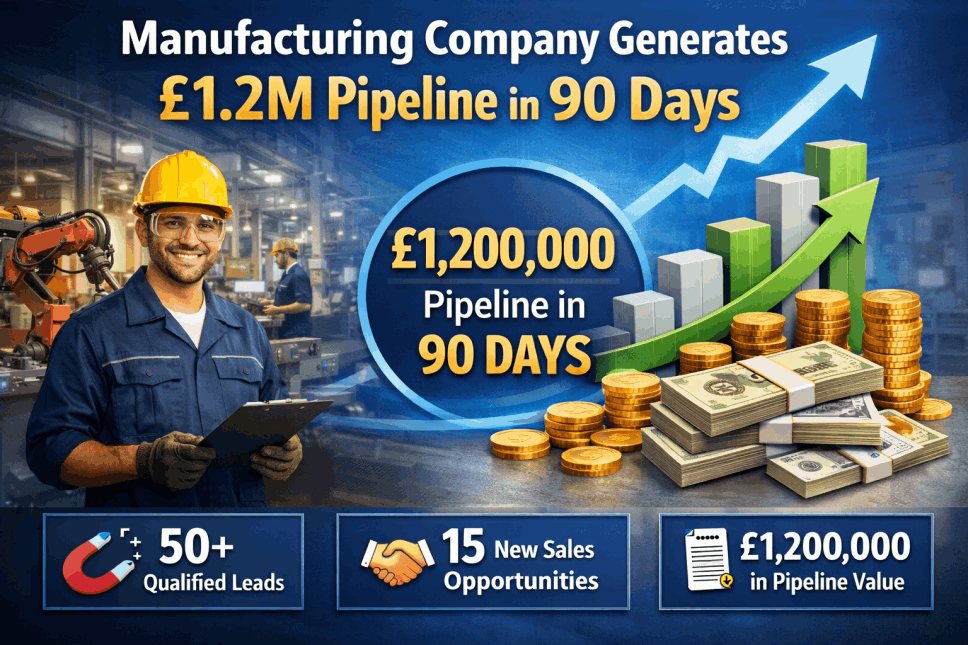
127 Qualified Leads Generated (90 days)
43 Sales Appointments Set
£1.2M Pipeline Value Created
12 Deals Closed (6 months)
£340K Revenue Generated (Year 1)
2,267% ROI (First Year)
"Before working with Global Collaborations, we were stuck in a cycle of waiting for referrals. Their systematic approach to lead generation gave us a predictable flow of qualified opportunities. Within six months, we'd closed £340,000 in new business—more than paying for their services 20 times over. More importantly, we now have a repeatable process for pipeline generation."
— Operations Director, Precision Engineering Manufacturer
Industry: B2B SaaS (Project Management) Company Size: 28 employees, £2.1M ARR
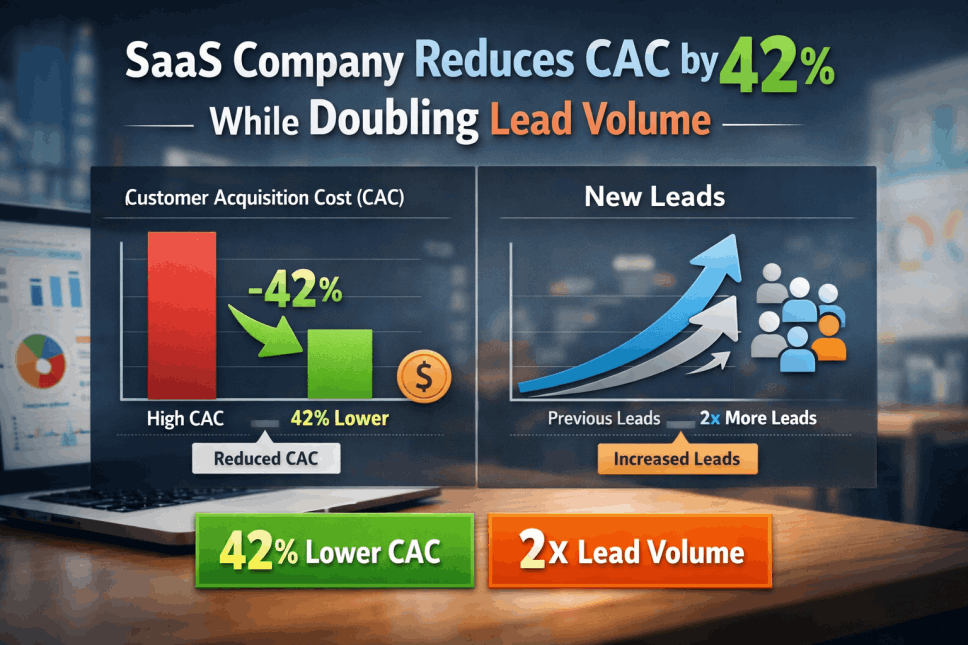
A rapidly growing SaaS company offering project management software was struggling with high customer acquisition costs (£3,200 per customer) and unpredictable lead flow. Their marketing team generated MQLs through content and paid advertising, but SQL conversion rate was only 8%, and sales team complained about lead quality.
• High CAC (£3,200) eating into profitability
• Low MQL → SQL conversion (8% vs. 15-20% target)
• Unpredictable monthly lead flow (15-80 MQLs/month)
• Sales and marketing misalignment on lead quality
• Long sales cycle (average 4.2 months)
We implemented a comprehensive lead generation program focusing on mid-market companies in construction and professional services:
1. ICP Refinement: Analyzed their 50 best customers to identify common characteristics beyond basic demographics—specifically looking at tech stack, project complexity indicators, and team size
2. Sales & Marketing Alignment: Facilitated workshops to establish agreed-upon SQL criteria and handoff process
3. Account-Based Approach: Shifted from broad lead generation to targeted account lists (500 companies per quarter) matching refined ICP
4. Personalized Outreach Sequences: Created industry-specific messaging for construction vs. professional services prospects
5. Lead Scoring Implementation: Developed scoring model based on fit + engagement to prioritize follow-up
6. Sales Enablement: Created battle cards and case studies specific to each industry
285 Qualified SQLs Generated (6 months)
42% Reduction in CAC
23% SQL → Customer Conversion Rate
3.1 Average Months to Close (down from 4.2)
£890K New ARR (12 months)
47 New Customers Acquired
"The transformation wasn't just in lead volume—though we doubled that—but in lead quality. Our sales team went from complaining about bad leads to asking for more. The 42% reduction in customer acquisition cost completely changed our unit economics and made our growth sustainable. This partnership literally saved our scaling plan."
— Sales Director, B2B SaaS Company
Our lead generation services are structured to deliver measurable ROI while remaining accessible to growing B2B companies. Pricing depends on your target market complexity, volume requirements, and service scope.
Most Popular
Ideal for companies testing lead generation or with smaller markets
• 8-10 qualified appointments per month
• Single target segment/persona
• Email + LinkedIn outreach
• Monthly strategy calls
• CRM integration and reporting
Typical ROI: 200-300% in year 1
Popular
For companies ready to scale with predictable lead flow
• 10-20 qualified appointments per month
• 2-3 target segments/personas
• Email + LinkedIn + Phone outreach
• Bi-weekly strategy and optimization
• Full sales enablement support
• Dedicated account manager
• Advanced reporting and analytics
Typical ROI: 300-500% in year 1
Premium
For companies requiring high-volume, multi-market campaigns
• 20+ qualified appointments per month
• Multiple segments, industries, or geos
• Full multi-channel orchestration
• Account-based marketing (ABM)
• Weekly strategic planning
• Dedicated SDR team
• Custom integrations and workflows
• Executive business reviews
Typical ROI: 400-700% in year 1
We're confident in our lead generation approach because we've refined it through over 150 client engagements. That's why we offer a 90-day performance guarantee: if we don't deliver the agreed-upon number of qualified appointments in the first 90 days, we'll continue working at no additional cost until we do.
You must have sales team capacity to handle appointments, respond to leads within 24 hours, and follow agreed-upon sales process.
Let’s build a targeted outreach strategy that works.
Phone: +44-1522-301-002
Direct: +44-7450-301-002
Email: hello@gcuk.group
Generating high-quality B2B leads requires a systematic approach that combines precise targeting, multi-channel outreach, and rigorous qualification. Start by developing a detailed Ideal Customer Profile (ICP) that goes beyond basic demographics to include behavioural signals, tech stack, growth indicators, and buying triggers. Then implement a multi-channel strategy that reaches decision-makers through email, LinkedIn, phone, and targeted content.
At Global Collaborations UK, we've helped over 100 companies improve lead quality by 40-60% through our proprietary approach that combines:
• Data-driven targeting: We use 15+ data points to identify prospects who match your ICP and show buying intent
• Personalized outreach: Generic messaging generates 2-3% response rates; personalized, value-driven messages generate 15-20% response rates
• Multi-touch sequences: It takes an average of 8-12 touchpoints to generate a qualified lead; we orchestrate these across channels
• Rigorous qualification: We implement BANT (Budget, Authority, Need, Timing) or MEDDIC frameworks to ensure only genuinely qualified leads reach your sales team
The results speak for themselves: our clients typically see a 3-5x increase in qualified sales appointments within the first 90 days, with a 40% average increase in close rates due to improved lead quality.
B2B lead generation costs vary significantly based on your industry, target market, average deal size, and the channels you use. However, understanding typical costs and ROI benchmarks helps you evaluate options and set realistic expectations.
Typical B2B Lead Generation Costs:
• Cost per lead (CPL): £50-£500 depending on industry complexity and target seniority. Enterprise software leads targeting C-suite executives typically cost £200-£500, while SMB-focused leads may cost £50-£150.
• Cost per qualified lead: 2-3x higher than CPL, ranging from £150-£1,500. Remember, a qualified lead has been vetted for budget, authority, need, and timing.
• Monthly retainer for outsourced lead generation: £2,000-£10,000+ depending on scope, channels, and volume targets
• In-house lead generation team costs: £45,000-£65,000 annually per SDR (salary, benefits, tools, training, management overhead)
Expected ROI:
Professional lead generation services typically deliver 200-400% ROI within 12 months when properly implemented. Here's what that looks like in practice:
Example ROI Calculation:
• Monthly investment: £5,000
• Qualified leads per month: 25-30
• Sales conversion rate: 20% (industry average for qualified B2B leads)
• Closed deals per month: 5-6
• Average deal value: £15,000
• Monthly revenue generated: £75,000-£90,000
• Annual investment: £60,000
• Annual revenue generated: £900,000-£1,080,000
• ROI: 1400-1700%
Critical success factors for achieving strong ROI include:
• Clearly defined ideal customer profile
• Alignment between marketing and sales on lead qualification criteria
• Rapid follow-up (leads contacted within 5 minutes convert 21x higher than those contacted after 30 minutes)
• Multi-channel approach (companies using 3+ channels see 287% higher purchase rates)
• Continuous optimization based on conversion data
Most of our clients see measurable results within 60-90 days, with ROI positive by month 6-9 as their sales teams close deals from the generated pipeline.
The timeline for lead generation results varies based on your approach, target market, and sales cycle, but here's what you can realistically expect at each stage:
Immediate Results (Week 1-4): Setup and Early Signals
• Ideal Customer Profile (ICP) defined and documented
• Target prospect lists built (typically 500-2,000 contacts)
• Initial outreach campaigns launched across channels
• First responses and conversations (expect 2-5% initial response rate)
• Early interest indicators and meeting requests
Early Traction (Month 2-3): Pipeline Building
• Qualified sales appointments scheduled (expect 10-25 per month depending on volume)
• Sales pipeline begins to build with opportunities
• Conversion data informs optimization (which messages, which channels perform best)
• A/B testing reveals winning approaches
• Response rates improve as messaging is refined (typically 15-25% improvement)
Results Materialize (Month 4-6): Deals Close
• First deals close (timing depends on your sales cycle length)
• ROI becomes measurable
• Process optimization based on closed deals vs. lost deals
• Pipeline velocity increases as sales team becomes more efficient with qualified leads
Optimization Phase (Month 7-12): Predictable Results
• Lead generation becomes predictable and scalable
• Clear understanding of: cost per lead, cost per qualified lead, lead-to-customer conversion rate
• Refined targeting reduces wasted outreach by 40-60%
• Established cadence of qualified appointments feeding sales pipeline
• ROI typically reaches 200-400%
Critical Success Factors for Faster Results:
• Sales cycle length: Shorter cycles (1-3 months) see revenue faster than complex enterprise sales (6-12 months)
• Response time: Companies responding to leads within 5 minutes see 21x higher conversion
• Sales team readiness: Your team must be equipped to handle increased qualified opportunities
• Continuous optimization: Companies that review metrics weekly and optimize bi-weekly see 35% faster results
In our experience with over 150 B2B clients, companies typically see:
• Month 1: First qualified appointments (but minimal revenue)
• Month 3: 3-5x increase in qualified pipeline vs. previous baseline
• Month 6: First significant closed revenue from lead generation efforts
• Month 12: Predictable, scalable lead generation engine with positive ROI
The key is treating lead generation as a process, not a campaign. Companies that commit to 12 months of consistent execution see dramatically better results than those expecting overnight success.
Marketing Qualified Leads (MQLs) and Sales Qualified Leads (SQLs) represent different stages in the buyer's journey, and understanding this distinction is crucial for alignment between marketing and sales teams.
Marketing Qualified Leads (MQLs) are prospects who have shown interest in your company through marketing activities—downloading a whitepaper, attending a webinar, visiting pricing pages multiple times, or engaging with email campaigns. They've raised their hand to indicate interest but haven't been vetted for sales readiness. MQL criteria typically include demographic fit (right industry, company size) and engagement level (content downloads, website visits, email opens).
Sales Qualified Leads (SQLs) have been vetted by sales (or a lead qualification team) and meet specific criteria indicating they're ready for direct sales engagement. SQL criteria typically include:
• Budget: They have allocated or accessible budget for your solution
• Authority: You're speaking with a decision-maker or strong influencer
• Need: They have a genuine problem your solution solves
• Timing: They have a defined timeline for making a decision (typically within 3-6 months)
In our experience working with B2B clients, the average MQL-to-SQL conversion rate ranges from 13-25%. Companies with strong lead qualification processes see rates at the higher end of this range. The key is establishing clear, agreed-upon criteria between marketing and sales for what constitutes an SQL, then implementing a systematic process to assess leads against these criteria.
We help clients bridge the MQL-SQL gap by implementing lead scoring models, qualification frameworks, and sales development representative (SDR) processes that ensure only genuinely sales-ready leads consume your sales team's valuable time.
The B2B lead generation landscape has evolved significantly, and the most effective approach in 2026 is multichannel, not relying on any single source. Based on our work with over 150 B2B clients, here are the highest-performing channels ranked by effectiveness:
1. LinkedIn Outreach (Highest ROI for B2B)
LinkedIn remains the dominant B2B lead generation platform, with 62% of B2B marketers generating leads through it. Key tactics include:
• Personalized connection requests to decision-makers (25-35% acceptance rate when properly personalized)
• Value-driven InMail messages to prospects outside your network (10-15% response rate for well-crafted messages)
• Content engagement - commenting on prospect posts, sharing valuable insights (builds familiarity before outreach)
• LinkedIn Sales Navigator for advanced targeting and tracking (essential for enterprise sales)
Average cost per lead on LinkedIn: £75-£250 depending on target seniority and industry
2. Email Outreach (Best for Scale)
When executed properly, email generates the highest volume of leads at the lowest cost. Success requires:
• High-quality data: Lists with verified emails (70%+ deliverability required)
• Personalization at scale: Dynamic fields beyond just {FirstName}
• Value-first messaging: Focus on solving their problem, not your features
• Multi-touch sequences: 5-7 emails over 2-3 weeks (average 15-25% open rate, 2-5% response rate)
• A/B testing: Continuous optimization of subject lines, CTAs, and messaging
Average cost per lead via email: £25-£100
3. Phone Outreach (Highest Conversion Quality)
While phone is resource-intensive, it generates the highest-quality conversations. Modern phone prospecting involves:
• Warm calling (following email or LinkedIn engagement) rather than cold calling
• Research-backed conversations: Understanding prospect's business before calling
• Permission-based approach: "Is now a good time?" respect increases engagement
• Value proposition in 30 seconds: Respect their time
Phone outreach generates 3-5x higher qualification rates than email alone, though requires more resources. Average connect rate: 8-12%, conversation rate: 3-5% of dials.
4. Content Marketing & SEO (Lowest Cost, Longest Timeline)
Content marketing generates 3x more leads than traditional outbound at 62% lower cost, but requires 6-12 months to gain traction:
• Thought leadership articles addressing specific problems
• In-depth guides and whitepapers (2,000+ words) that rank for buyer intent keywords
• Case studies demonstrating proven results
• Webinars and video content (video content generates 66% more qualified leads)
Average cost per lead via content: £35-£75 (but requires upfront investment)
5. Referral Programs (Highest Close Rate)
Referred leads convert 30% better and have 37% higher retention than other sources:
• Structured referral programs with clear incentives
• Customer advocacy programs that make referring easy
• Strategic partnerships with complementary service providers
he Winning Formula: Integrated Multi-Channel Approach
Our clients achieve the best results using an integrated approach:
1. LinkedIn connection request to establish initial contact
2. Email sequence providing value and building familiarity (Days 3, 7, 14)
3. Phone follow-up to engaged prospects (Day 21)
4. Content nurturing for those not yet ready to buy
This integrated approach generates 287% higher engagement than single-channel outreach and reduces cost per qualified lead by 35-50%.
This decision depends on your budget, timeline, current capabilities, and growth stage. Both approaches have merits, and many successful companies use a hybrid model. Here's a comprehensive comparison to guide your decision:
Outsourced Lead Generation
Best for: Companies seeking rapid results, those without existing sales development expertise, organizations testing new markets, or businesses wanting predictable costs
Advantages:
• Faster time to results: Expert agencies can launch campaigns within 2-3 weeks vs. 3-6 months to hire and train in-house team
• Lower upfront investment: £2,000-£10,000/month vs. £45,000-£65,000/year per SDR (including salary, benefits, tools, training, management)
• Access to expertise and proven processes: Agencies bring experience from dozens or hundreds of clients across industries
• Scalability: Easy to scale up or down based on results and budget
• Technology included: CRM, data providers, email tools, and phone systems typically included
• Lower risk: Can change vendors if results don't materialize; no employment obligations
Disadvantages:
• Less product expertise: External teams need time to understand your offering deeply
• Reduced control: You depend on their processes and timelines
• Brand representation concerns: Outsourced reps represent your brand; quality varies
• Long-term cost: Over 2-3 years, in-house may be more cost-effective
In-House Lead Generation Team
Best for: Companies with complex products requiring deep expertise, organizations with budgets for 3+ SDRs, businesses at scale needing full control
Advantages:
• Deep product knowledge: Team becomes expert in your offering and can handle complex questions
• Full control: Complete oversight of processes, messaging, and priorities
• Brand alignment: Your employees understand and embody company culture
• Long-term cost efficiency: After initial investment, per-lead costs decrease over time
• Proprietary knowledge: Your team builds institutional knowledge that stays with you
• Career development: SDR role serves as farm system for future sales leaders
Disadvantages:
• Slower time to results: 3-6 months to recruit, hire, onboard, train, and ramp to productivity
• Higher upfront costs: £45K-£65K per SDR annually, plus £15K-£30K for tools, training, management
• Management overhead: Requires dedicated sales development manager (recommended at 5+ SDRs)
• Hiring risk: SDR turnover averages 25-35% annually; bad hires are costly
• Limited expertise: Unless you hire experienced SDRs, expect learning curve and suboptimal results initially
• Fixed costs: Salaries continue regardless of results
The Hybrid Approach (Recommended for Many Companies)
Many of our most successful clients use a blended model:
Phase 1 (Months 1-6): Outsourced
• Partner with agency to generate immediate pipeline
• Test messaging, channels, and ideal customer profiles
• Validate that lead generation can drive revenue before major internal investment
• Use agency expertise to establish baseline processes
Phase 2 (Months 6-12): Hybrid
• Hire 1-2 SDRs to work alongside outsourced team
• Agency provides training and process documentation
• In-house SDRs focus on highest-value accounts or most complex products
• Outsourced team continues volume work
Phase 3 (Year 2+): Primarily In-House with Outsourced Overflow
• Build 3-5 person in-house SDR team
• Retain outsourced partner for overflow, new market testing, or campaign work
• Best of both worlds: control and expertise internally, flexibility externally
Decision Framework:
Choose Outsourced if:
• You need results within 60-90 days
• Your budget is £2K-£10K/month but can't support £45K+ in fixed costs
• You lack sales development expertise internally
• You're testing a new market or product
• Your sales team is too busy to train and manage SDRs
Choose In-House if:
• Your product requires deep technical expertise (6+ months to learn)
• You have budget for 3+ SDRs (economies of scale require minimum team size)
• You can dedicate management resources to building and coaching team
• Your sales cycle is 6+ months (long-term relationship building required)
• You have successful sales hiring and training processes
At Global Collaborations UK, we help clients make this decision based on their specific situation. We've also helped dozens of clients transition from fully outsourced to hybrid to in-house models as their businesses scale, providing process documentation and training to ensure smooth transitions.
Founded in 2019 with proven track record across diverse industries
From SMEs to enterprises across manufacturing, tech, and services
Senior team brings decades of hands-on sales and business development expertise
Long-term partnerships built on delivering measurable results
Project-managed delivery with clear milestones and visible progress
Clients see measurable return on investment within 6-12 months
Enter one or more keywords in the field below and search away.
Found {searchTotal} result(s) for '{searchString}'.
No results were found for '{searchString}'.
{index}. {header:This dummy header will be replaced.}
{body:This is just some example text that helps you understand what your search results will look like. In this example, we're searching for the word 'dummy', which is highlighted, if you have highlighting enabled. This body tag will be replaced with the actual body text of a search result, so you don't have to change this text.}
{page:example.html}